
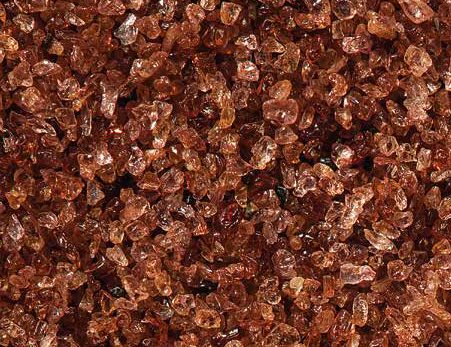
When ordering garnet abrasive you will see terms such as "30/60" or "80 mesh"; these describe the grain size. Choosing the right mesh directly affects blasting speed, the profile on the surface and material consumption. In this post we explain what garnet mesh sizes mean, the ranges in our product line and which mesh to choose for which job.
What is mesh and how is it read?
Mesh is the number of openings per linear inch of a sieve. The higher the number, the smaller the openings and the finer the grain. Two numbers describe a range: 30/60 mesh, for example, means grains that pass a 30-mesh sieve but are retained on a 60-mesh sieve. A single number such as "80 mesh" indicates an approximate size; the exact range is on the product data sheet. For a general definition of the scale, see the Wikipedia article on mesh (scale).
Garnet mesh sizes and applications
The mesh ranges on our garnet product page are:
| Mesh | Size range (mm) | Application |
|---|---|---|
| 20/40 | 0.42 – 0.85 | Ship and heavy industry surface cleaning |
| 30/60 | 0.25 – 0.60 | General blasting and floor preparation |
| 80 | 0.18 – 0.30 | Precision surface work |
| 120 | 0.10 – 0.18 | Waterjet cutting |
Which mesh should you choose?
- 20/40 mesh: for fast cleaning and a deeper profile on tough layers such as thick paint, heavy rust and mill scale.
- 30/60 mesh: a balanced choice for general blasting and the starting point for many pre-painting surface preparation jobs.
- 80 mesh: for precision work where a finer, more uniform surface is required.
- 120 mesh: the fineness listed for waterjet cutting on our product page; follow the mesh recommended by your cutting machine’s manufacturer.
The general rule is simple: coarse grains cut faster and create a deeper profile; fine grains leave a smoother surface but are slow on thick layers. The choice should follow the profile required by the paint manufacturer. For profile measurement, see our post on surface roughness.
Mesh, millimetres and FEPA
Abrasives are graded with different systems: garnet and plastic media usually by mesh, aluminium oxide and silicon carbide by FEPA "F" codes, and steel grit by SAE "G" codes. When comparing different materials, the safest approach is always to look at the size range in millimetres or microns. The general logic of all systems is explained in our post on grain size selection.
How mesh choice affects cost
The wrong mesh raises costs regardless of the price per kilo: garnet that is too fine uses more material and time on thick layers, while garnet that is too coarse can create a deeper profile than needed and increase paint consumption. For the other factors behind the price of garnet, see our post on garnet abrasive prices.
Frequently asked questions
What does 30/60 mesh garnet mean?
It means garnet grains that pass a 30-mesh sieve but are retained on a 60-mesh sieve. The range on our product page is 0.25 – 0.60 mm, and it is a common choice for general blasting.
Which garnet mesh is most used for blasting?
30/60 mesh is often preferred for general surface preparation before painting. 20/40 is considered for heavy rust and thick coatings, and 80 mesh for finer surfaces. The exact choice depends on the required profile.
Can garnet of different meshes be mixed?
It is not recommended. Mixing makes the size distribution unpredictable and the result inconsistent. It is better to choose one mesh for the job and set the parameters accordingly.
Ask us about the right garnet mesh
Tell us about your surface, the layer to be removed and the profile you need, and we will choose the right mesh together. For general information on garnet, see what is garnet abrasive, or fill in the quote form for pricing.