
Over time, moulds become fouled with release agent build-up, burnt plastic or rubber residue, oxide and scale. This fouling causes stains on parts, dimensional deviation and release problems. Blasting is one way to clean a mould quickly with little or no disassembly; but a mould is an expensive, precise tool, and the wrong abrasive can permanently damage its surface. In this post we explain how to choose a mould cleaning abrasive by mould type and by the purpose of the job.
The goal of mould blasting: cleaning or surface texture?
Moulds are blasted for two different purposes, and the abrasive changes accordingly:
- Maintenance cleaning: the goal is to remove deposits without changing the mould surface or its dimensions. Gentle abrasives with low cutting power are used.
- Texturing (matt finish): the goal is to give the mould surface a deliberate, even profile so that the moulded part has a matt look. A sharper abrasive is needed.
- Preparation after repair: bringing an area that has been welded or machined back to the same look as its surroundings.
Polished (mirror-finish) areas of a mould should not be blasted; blasting removes the gloss and the surface would have to be polished again. These areas should be masked or cleaned with another method.
By mould type
- Plastic injection moulds: burnt plastic and release agent collect in vents and fine features. They usually have delicate surfaces and need a gentle abrasive and low pressure.
- Aluminium die casting dies: release agent residue and oxide build up. The dies are made of hot-work tool steel, but dimensions and surface must still be protected.
- Tyre and rubber moulds: rubber and release residue stick to the surface during vulcanisation; they have fine patterns and vent holes.
- Glass and bottle moulds: lubricant and oxide residue form; surface quality passes directly to the product.
For general information on the injection process and the mould, see the Wikipedia article on injection moulding.
Abrasives used for mould cleaning
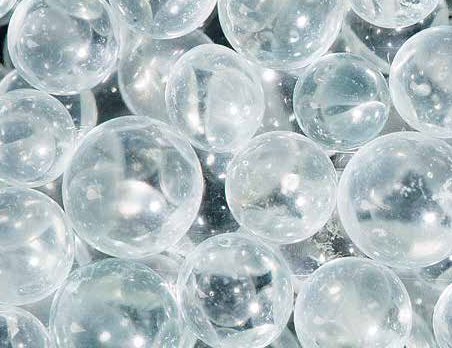
- Glass beads: the round grains clean by impact rather than cutting. They remove deposits without profiling the mould surface and leave an even satin look; one of the most common choices for mould maintenance.
- Plastic media: one of the options with the lowest cutting power. Removes residue from delicate moulds and fine details without changing the surface.
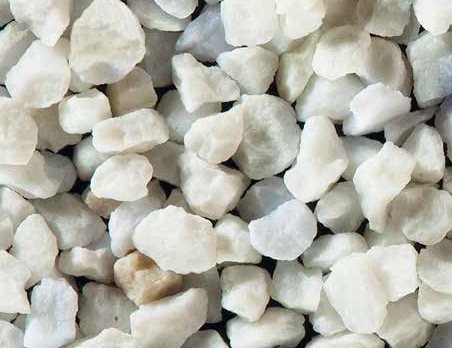
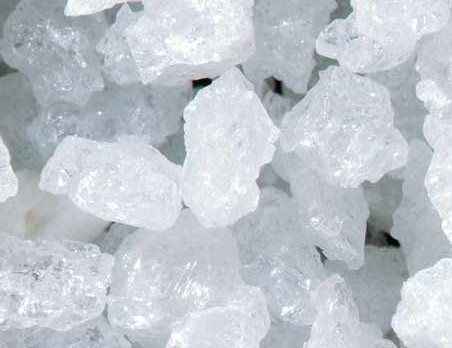
- White aluminium oxide: angular and sharp; used with a fine grain and under control to texture a mould or remove very hard deposits rather than for routine cleaning. Contains no iron.
We cover surface finishing with glass beads in surface finishing with glass beads and the use of plastic media in plastic media blasting.
Protecting the mould surface
- Start with low pressure and test first on a hidden area of the mould.
- Keep the nozzle moving; working on one spot can round sharp edges and change dimensions.
- Mask polished surfaces, parting lines, ejectors and precise fits.
- Do not let abrasive get into vents and cooling channels; blow all channels clean with clean air afterwards.
- Use separate, clean abrasive for moulds; abrasive contaminated on other jobs can stain the mould.
To keep the abrasive clean, the separator in the recovery system must work properly; details in abrasive recycling in blasting.
After blasting, blow abrasive dust off the mould surface with clean compressed air, apply the protective recommended by the mould maker and check the part surface on the first shots. This shows straight away whether the cleaning has carried through to the product.
Grain size and surface texture
Fine grain ranges are usually preferred for mould maintenance; a coarse grain cleans faster but increases the risk of marking the surface. When texturing a mould, the grain size directly determines the matt look of the product; using the same grain and settings on every cavity of the same mould avoids differences in appearance. See our grain size selection guide for the general logic and how to measure surface roughness for measuring the profile.
Frequently asked questions
What abrasive is used for mould cleaning?
Maintenance cleaning mostly uses glass beads and plastic media; both remove deposits without noticeably profiling the mould surface. When a mould needs a matt texture, fine white aluminium oxide is preferred.
Does blasting damage a mould?
Blasting with a suitable abrasive and low pressure removes very little material from the mould surface. Hard, coarse grains, high pressure or working on one spot for long can round sharp edges, dull glossy surfaces and change dimensions.
Can a polished mould surface be blasted?
It is not recommended. Blasting dulls a mirror-finish surface and it would need polishing again. These areas should be masked or cleaned with another method recommended by the mould maker.
Get a quote for mould cleaning abrasives
Tell us your mould type, the residue you want to remove and the cabinet or equipment you use, and we will choose the right abrasive and grain size together. Browse all products on the products page or fill in the quote form for pricing.