
Even when two abrasives are sold in the same grain size, they do not do the same job. One cleans fast while the other is slow; one cycles through a cabinet many times while the other turns to dust. The reason is the physical properties of the material. In this post we go through the properties of blasting abrasives one by one and explain how each affects the result. For a step-by-step selection guide, see how to choose a blasting abrasive.
Hardness: how much can the abrasive cut?
Hardness determines how much of a mark a grain can leave when it hits the surface. Mineral abrasives are usually rated on the Mohs scale. According to our product pages, white and brown aluminium oxide are Mohs 9, black silicon carbide 9–9.5, garnet 7.5–8, glass abrasive and glass beads 5.5–6, and plastic media about 3–4. Metallic abrasives are rated on scales such as Rockwell (HRC). For the logic of the Mohs scale, see the Wikipedia article on the Mohs scale.
- Hard abrasive: removes rust, mill scale and thick coatings faster and also works on hard surfaces.
- Soft abrasive: protects the base material; suitable for paint stripping and delicate parts.
- Note: an abrasive much harder than the surface increases the risk of deep marks and embedding on soft metals.
Grain shape: angular or round?
Grain shape decides whether the abrasive cuts or peens the surface. This directly changes the look and the profile after blasting.
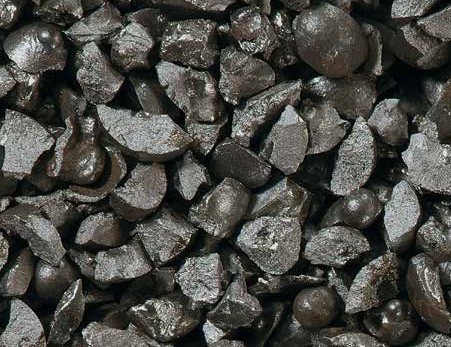
- Angular grains (aluminium oxide, garnet, steel grit, silicon carbide): cut the surface and leave a profile that paint and coatings can grip.
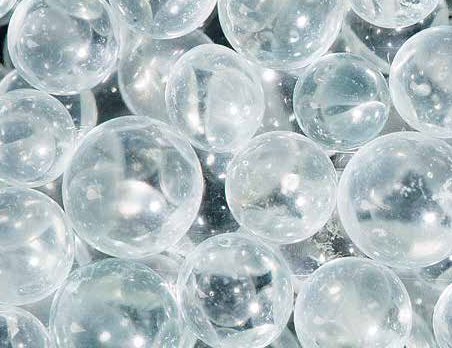
- Round grains (glass beads, steel shot): peen the surface; they clean without cutting a profile and give a satin, smoother look.
Choose angular grains when a profile is needed before coating, and round grains when appearance and light cleaning come first. Shot and grit are compared in steel shot vs steel grit.
Density: the energy a grain carries
Of two grains hitting at the same speed, the denser one has more mass and therefore more impact energy. According to our product pages, steel grit is 7.8 g/cm³, aluminium oxide and garnet about 3.9–4.2 g/cm³, silicon carbide about 3.2 g/cm³, glass abrasives about 2.5 g/cm³ and plastic media about 1.5 g/cm³.
- Dense abrasive: effective on heavy rust and mill scale, but needs more air to convey in pressure blasting.
- Light abrasive: acts more gently, stays airborne longer and is more prone to forming a dust cloud.
Grain size
Grain size determines how many grains hit the surface per unit of time and how large each impact mark is. A coarse grain strips thick coatings and leaves a deep profile; a fine grain sweeps the surface faster and more evenly with more grains. Grain size is not judged alone but together with hardness and shape. FEPA and mesh designations and the selection logic are explained in our grain size selection guide.
Friability and recycling
Every grain breaks down a little on impact. How fast it breaks determines how many times the abrasive can be reused and how much dust it creates.
- Durable abrasives (steel grit and shot, aluminium oxide): recovered many times in cabinets and wheel blast machines.
- More friable abrasives (such as glass abrasive): become fine in fewer cycles; usually used once or a limited number of times.
- Result: an abrasive with a low price per kilo but high friability can cost more per square metre.
Details are in recycling blasting abrasive.
Cleanliness: dust, moisture and contamination
The cleanliness of the abrasive affects both working conditions and coating life:
- Dust and fines: reduce visibility and can stick to the surface and end up under the coating.
- Moisture: makes the abrasive clump and block the hose and nozzle; dry storage is essential.
- Soluble salts: contaminated abrasive can carry salts to the surface, raising the risk of corrosion under the coating.
- Free silica: sands containing silica pose a serious health risk. See safety in abrasive blasting.
Iron content
Carbon steel abrasives, or abrasive previously used on steel, can leave iron particles on stainless steel and aluminium. These later show up as rust stains. Iron-free options such as white aluminium oxide, glass beads or stainless abrasives are preferred on these materials. Details are in stainless steel blasting. For a general classification of abrasive types, see types of blasting abrasives.
Frequently asked questions
What is the most important property of a blasting abrasive?
There is no single one; the priority depends on the job. Hardness and angular grains matter for a profile before coating, round grains for appearance, friability and recyclability for cost, and an iron-free composition for stainless steel and aluminium.
Is a harder abrasive always better?
No. A hard abrasive cuts faster but can leave deep marks on soft metals and damage delicate parts. The abrasive should be chosen according to the surface material and the required result.
Where can I find the properties of a blasting abrasive?
Hardness, density, grain shape and grain size are listed in the product’s technical data. You can find the technical values of our products on the product pages and ask us about suitability for your application.
Let’s choose the right properties for your application
Tell us the material you blast, your equipment and the surface you need, and we will choose an abrasive with the right hardness, shape and grain size together. Technical values for all products are on the products page; for pricing, fill in the quote form.