
Most rubber and silicone parts coming out of the mould carry a thin overflow along the parting line of the mould. This excess is called flash. On parts such as O-rings, gaskets, seals and bellows, flash spoils the appearance and can also affect sealing and assembly. In this post we explain the methods of rubber deflashing, how cryogenic deflashing works and what to look for when choosing the polyamide (PA) media used for the job.
Why does flash form on rubber parts?
Rubber is shaped by injection, transfer or compression moulding. However precisely the two halves of the mould are machined, the material under pressure seeps a little into the parting line and the vent channels. After vulcanisation this thin layer cures while still attached to the part.
- Mould wear: as the parting surfaces wear over time, the flash gets thicker.
- Excess material charge: putting more compound into the cavity than needed increases overflow.
- Part geometry: in moulds with holes, recesses and multiple parts, the flash line gets longer.
Preventing flash completely is often not possible. That is why a separate deflashing step is planned in the production line.
Rubber deflashing methods
Which method to choose depends on the part quantity, size, material and the acceptable surface quality. The common methods are:
- Manual deflashing: done with a knife, scissors or sandpaper. It can be used for small batches and large parts, but labour costs are high and the result varies from person to person.
- Tumbling: parts are rotated in a drum and the flash is torn off by friction. It works on simple geometries but may fall short on fine details.
- Cryogenic deflashing: parts are cooled with liquid nitrogen and the embrittled flash is broken off by blasting soft polymer media. It is common in series production and for complex parts.
- Cutting and grinding fixtures: done with special fixtures made for a particular part. It is preferred for single-type, high-volume parts.
How does cryogenic deflashing work?
The principle behind the cryogenic method is simple: thin flash cools much faster than the thick body of the part. Below a certain temperature rubber loses its elasticity and becomes brittle. At that moment the impacting media breaks the flash, while the body, which has not cooled as much yet, is not damaged. You can find a general definition of the method in the cryogenic deflashing article.
- The parts are loaded into the basket or drum of the machine.
- The chamber is cooled with liquid nitrogen; as the parts rotate they are evenly exposed to the cold environment.
- A turbine throws the media onto the rotating parts and the brittle flash breaks off.
- The media and the broken flash are separated in the sieve system; the media is returned to the cycle.
- The parts are unloaded and inspected after they return to room temperature.
Cooling time, media speed and cycle time are adjusted to the material and the part. These values are set according to the machine manufacturer's recommendation and a trial batch.
Why is polyamide (PA) media used?
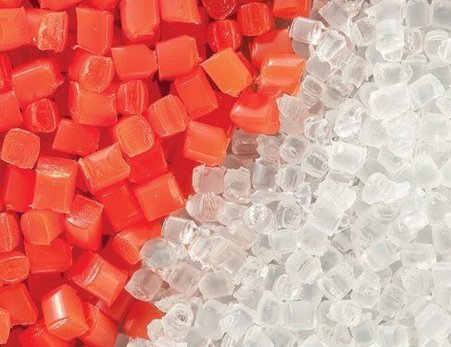
In cryogenic deflashing the job of the abrasive is not to wear the surface but to strike the brittle flash and break it off. That is why a soft, regularly shaped media is preferred over a hard, angular abrasive. PA blasting media is a polyamide 6 granulate made for this job. Because it is relatively soft, its effect on the part surface is low.
| Property | Value |
|---|---|
| Material | Polyamide 6, additives < 1% |
| Hardness | 2 – 3 Mohs |
| Grain shape | Cylindrical / cubic |
| Sizes (diameter x length) | 0.50 x 0.50 mm – 2.00 x 2.00 mm |
| Specific gravity | approx. 1.08 – 1.60 g/cm³ |
| Bulk density | approx. 0.7 g/cm³ |
| Melting point | approx. 215 – 225 °C |
| Colour | Red, natural |
| Packaging | 25 kg bags, 1 tonne per pallet |
PA media can be used in pressure, injection (suction) and turbine blasting systems. The product is recommended for deflashing rubber, silicone and thermoset parts.
How to choose grain size and colour
The right grain size depends on the thickness of the flash and the details of the part. The general approach is as follows:
- Thin flash and small parts: small grains (0.50 – 0.75 mm) reach details better.
- Thick flash and large parts: larger grains (1.00 – 2.00 mm) deliver a stronger impact.
- Parts with holes and recesses: to keep the media from getting stuck in holes, choose the grain size according to the hole diameter and check it in a trial batch.
- Colour: media in a colour that contrasts with the part makes any grain left on the part easier to spot.
For the final choice, the soundest approach is to assess the range recommended for your machine together with a sample part.
The difference between PA media and plastic media
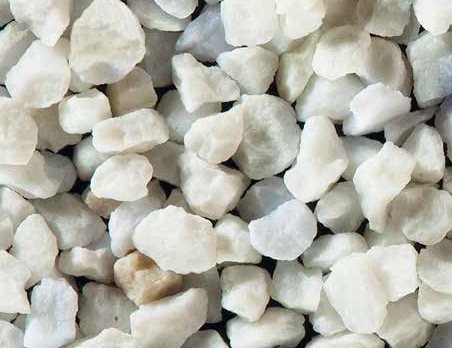
Both products are soft plastic abrasives, but they are designed for different jobs. Plastic media has a hardness of 3.5 – 4.0 Mohs and is angular. It is used for stripping paint and coatings from delicate surfaces and for cleaning moulds. PA media is softer (2 – 3 Mohs) and, with its cylindrical grain, applies impact rather than scraping the surface. For this reason PA media stands out in rubber and silicone deflashing, and plastic media in paint stripping. For the uses of plastic media, see our post on plastic media blasting.
Other soft abrasives for delicate cleaning at room temperature
Not every deflashing job requires a cryogenic machine. For jobs such as removing residue from mould surfaces or cleaning the surface of delicate parts without material loss, organic media can also be considered. Walnut shell grit is a blasting media with a hardness of 2.5 – 3.5 Mohs, made from crushed and screened walnut shells. Details are in our post on walnut shell blasting.
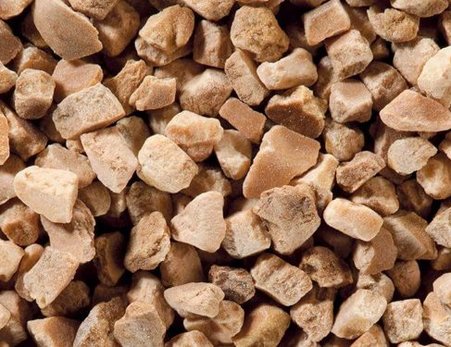
Which soft abrasive works on a rubber part depends on the material and the flash thickness. Always run a trial before moving to series production.
Points to watch in practice
- Trial batch: for a new part or material, first confirm the cooling time, grain size and cycle time with a small batch.
- Media residue: check whether any media remains after processing, especially on parts with holes.
- Sieve and dust: fine media worn down in use and broken-off flash must be separated by sieving; otherwise efficiency drops.
- Storage: polyamide absorbs moisture. Keep the bags closed in a dry place.
- Occupational safety: when working with liquid nitrogen, follow the machine manufacturer's safety instructions against cold burns and the risk of oxygen depletion in enclosed spaces.
Frequently asked questions
Can rubber flash be removed by blasting?
Yes, but at room temperature flexible rubber flash absorbs the impact and does not break off easily. For this reason flash on rubber and silicone parts is usually removed by blasting soft polymer media after cooling with liquid nitrogen. This is called cryogenic deflashing.
Which media is used in cryogenic deflashing?
Soft, cylindrical or cubic polymer granulates such as polyamide are commonly used. The media should break off the brittle flash without wearing the part surface. The grain size is chosen according to the flash thickness and the part details.
Can PA media be reused?
In cryogenic machines the media passes through a sieve system and is returned to the cycle. The fine fraction that wears down over time and the broken-off flash are separated, and the lost amount is topped up with new media. How long it can be used depends on the part and the machine settings.
Get a quote for PA media
If you are looking for PA media for your rubber, silicone or thermoset parts, send us the part type, the flash thickness and the machine you use. Let us determine the suitable grain size and colour together. You can find the product specifications on the PA blasting media page, browse all abrasives on our products page, and fill in the quote form for pricing. We ship by cargo throughout Türkiye and for export.