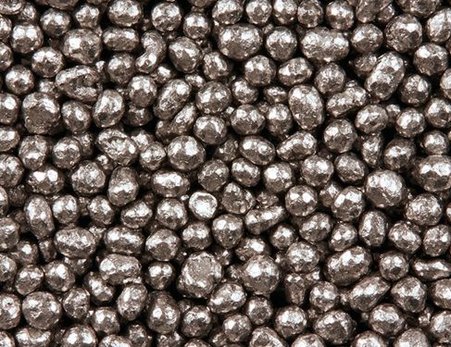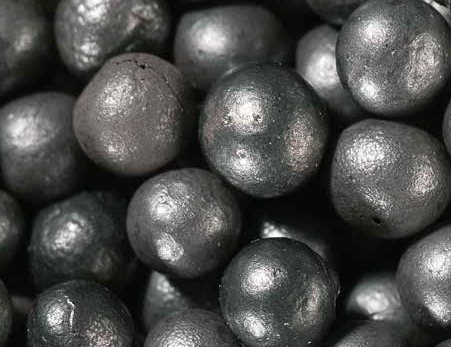

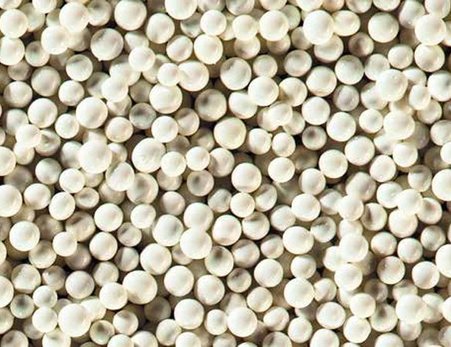
Ceramic beads are a spherical, hard blasting abrasive with a very low iron oxide content. Like glass beads, they work the surface without cutting it, but because they are heavier and harder they occupy a different place. In this article we explain what ceramic beads are, where they are used in blasting, which grit sizes are available and how they differ from glass beads and steel shot.
What are ceramic beads?
Ceramic blasting beads are produced by melting a zirconia (zirconium dioxide) based mixture and forming it into spherical grains. The grains are then screened and classified by size. The main values of our ceramic beads are:
- Hardness: approx. 7 – 7.5 Mohs
- Specific gravity: approx. 3.8 g/cm³; bulk density 2.1 – 2.4 g/cm³
- Chemical composition: ZrO₂ 61.98% · SiO₂ 27.77% · Al₂O₃ 4.57% · CaO 3.47% · TiO₂ 0.34% · Fe₂O₃ 0.14%
- Melting point: approx. 2100 °C
- Grain shape: spherical
With iron oxide at a very low 0.14%, ceramic beads are worth considering for surfaces where iron contamination is unwanted. For general information on zirconia itself, see the zirconium dioxide article.
Are grinding media and blasting beads the same thing?
A search for "ceramic beads" covers two different products. One is the millimetre-sized alumina or zirconia grinding media used for grinding and mixing in mills. The other is the micron-sized ceramic beads propelled onto a surface by compressed air or a turbine in a blasting machine.
- Grinding media: range from a few millimetres to centimetres in diameter and crush and mix material inside a mill.
- Blasting beads: range from 0 – 850 µm and clean, polish or peen the surface.
The product we supply is blasting beads. If you are looking for grinding media, the right product should be clarified from the start because of the difference in size and use.
Where are ceramic beads used in blasting?
When a spherical grain hits the surface, instead of cutting it leaves small dimples that compact the surface and give it an even appearance. The main applications in our product data are:
- Polishing and surface finishing: achieving a uniform matt-satin look on metal parts.
- Paint removal: removing coatings and residues without cutting the base material.
- Roughening: creating a controlled, even surface texture.
Because the iron oxide content is very low, they are considered for materials such as stainless steel, aluminium and titanium, where iron contamination can later lead to corrosion stains. We cover abrasive selection for stainless steel surfaces in detail in our article on stainless steel blasting.
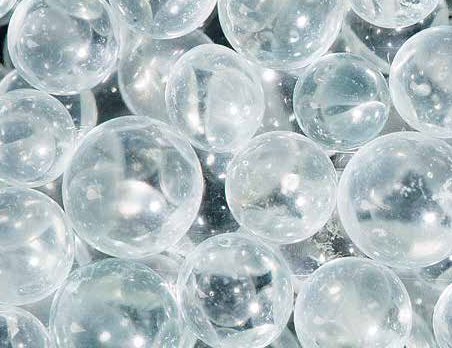
Ceramic beads or glass beads?
Both abrasives are spherical and work the surface without cutting it. The difference between them comes from weight and hardness:
| Property | Ceramic beads | Glass beads (GLSB) |
|---|---|---|
| Hardness | 7 – 7.5 Mohs | 6 Mohs |
| Specific gravity | approx. 3.8 g/cm³ | 2.5 g/cm³ |
| Grain shape | Spherical | Spherical |
| Main component | Zirconia | Soda-lime glass |
Higher density means more energy delivered to the surface at the same velocity. Ceramic beads can therefore give a more pronounced peening effect and faster cleaning. Being harder, they also generally tend to break less on impact than glass and can circulate in the system for longer. Glass beads, on the other hand, have the advantage in initial purchase cost and light work. For more on glass beads, see our article on surface finishing with glass beads.
Ceramic beads or steel shot?
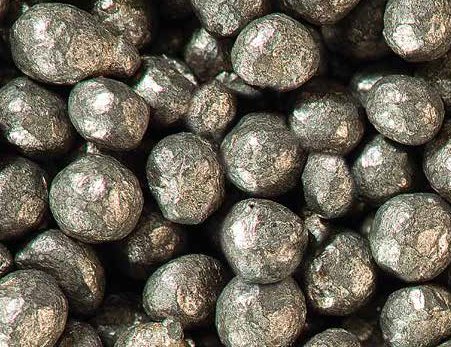
With a specific gravity of 7.8 g/cm³, steel shot is much heavier than ceramic. This makes it more effective in heavy work such as casting cleaning and thick scale. However, carbon steel shot can leave iron particles on stainless or aluminium surfaces. On such surfaces either stainless steel shot or ceramic beads are preferred. Because ceramic beads are lighter, they offer a more controlled effect on thin-walled and delicate parts.
Ceramic bead grit sizes
Ceramic beads are supplied in the size ranges below. Smaller grains give a finer, brighter surface; larger grains give a stronger effect and a more pronounced texture.
| Average grain size (µm) | General direction of use |
|---|---|
| 0 – 63 | Very fine surface, delicate parts |
| 0 – 125 | Fine surface finishing |
| 70 – 125 | Fine, uniform satin look |
| 125 – 250 | General cleaning and surface finishing |
| 250 – 425 | More pronounced texture, fast cleaning |
| 425 – 600 | Strong effect, thick residues |
| 600 – 850 | Strongest effect, large parts |
This column gives only a general direction. The final choice should be made by test blasting, according to the part material, the required surface value and the machine used. Ceramic beads can be used in pressure blasting systems and in wheel (turbine) blasting machines. We explain grit selection in general in our article on choosing blasting grit size.
Points to watch during use
- Pressure setting: excessive pressure wears the spherical grain unnecessarily and can leave unwanted marks on the surface. Start with low pressure and increase it according to the result.
- Separation and screening: broken fines and dust in the recovery system should be removed regularly; otherwise the surface quality changes.
- Mixing: do not mix ceramic beads with other abrasives in the same cabinet; this undermines the expectation of a result free of iron contamination.
- Dust and respiratory protection: as with any blasting job, dust is produced. Use suitable respiratory protection and a dust collection system.
Frequently asked questions
Can ceramic beads be reused?
Yes. Ceramic beads are a reusable blasting material. In cabinets with recovery systems and in wheel blasting machines they are circulated many times; the broken fines and dust are separated by screening.
Do ceramic beads contain iron?
In the chemical analysis of the product, the iron oxide (Fe₂O₃) content is 0.14%. This very low level is the main reason ceramic beads are considered for surfaces such as stainless steel and aluminium, where iron contamination is unwanted.
Do ceramic beads and glass beads give the same surface?
Because both abrasives are spherical, they give a similar, non-cutting surface. Since ceramic beads are heavier and harder, they can produce a more pronounced effect at the same settings. To achieve the same look, grain size and pressure need to be adjusted separately.
Request a quote for ceramic beads
Tell us the part material, the surface appearance you want and the blasting system you use, and we will work out the right size range together. Product values are on the ceramic beads page. You can browse all abrasives on our products page and fill in the quote form for pricing. We ship by cargo throughout Turkey and also for export.